EUROPEAN RIVER CRUISE - APRIL 2026
Sunday April 19 - Monday April 20, 2026
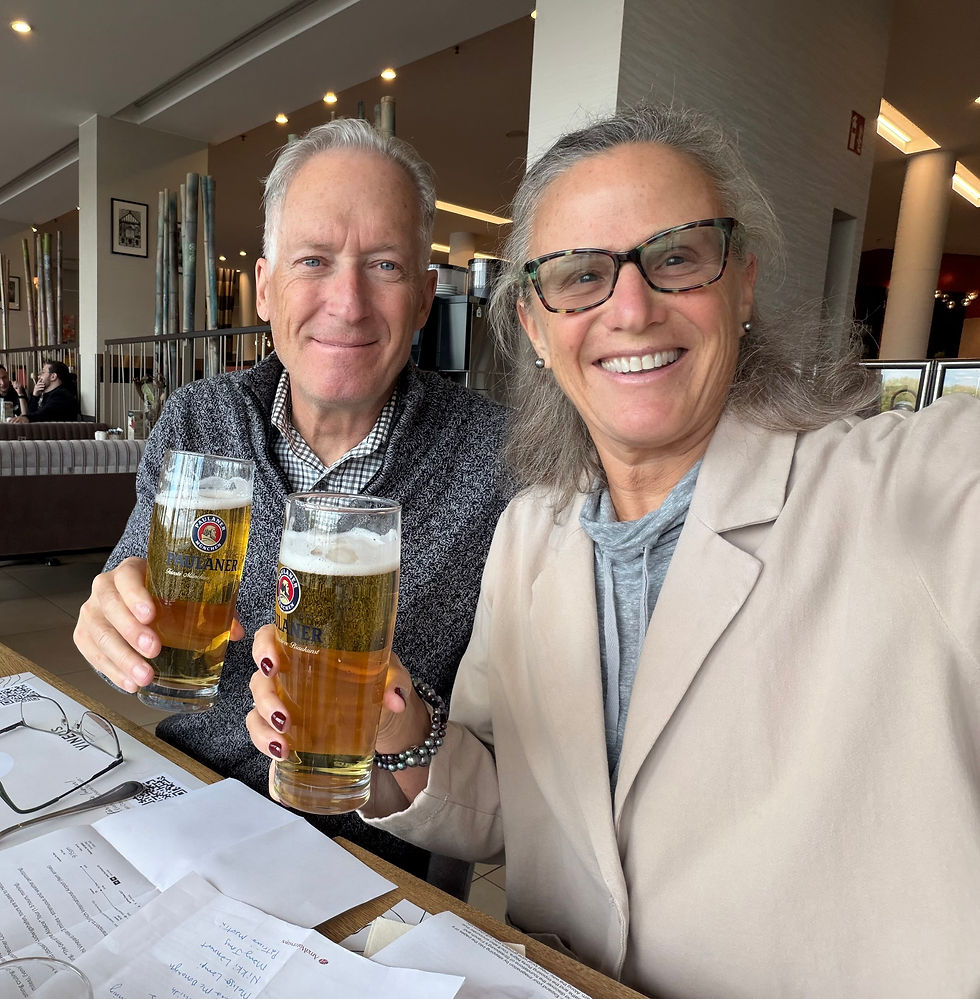
Easy travels to Germany - afternoon flight from MSN to DTW, a couple of hours there and then the overnight flight. We splurged for Delta One, which makes it oh so bearable! We boarded the plane, took off, had a really good dinner and before dessert, I was settled into my lay down bed - waking up in time for breakfast, 90 minutes from Frankfurt.
We hit a little snag in the Immigration / Border Control line, where those of us from outside the EU waited about an hour to get through the bottleneck. Besides our full flight, there was a flight of pushy people of Asian descent that kept budging in the line.
The tour company that arranged the hotel and cruise had also arranged a ride for us. As soon as we landed, I got a message that our driver was waiting for us. I messaged him back, but was a little nervous that he’d be able to hang out for the hour that it took us to navigate the line. But as soon as we left the baggage claim area, he was there for us.
It was about a 40-minute drive from the Frankfurt airport to the Hilton hotel in Mainz where we’ll meet the group tomorrow, to be transported to our river boat Wednesday morning. We arrived at the hotel just before noon. Our room wasn’t ready, but for an additional 50, we were able to upgrade to a river view room that was available immediately.
We settled into our room, brushed our teeth, and fell into bed for a two hour nap. In the old days, I’d try to stay awake to help the body integrate into the new time zone, but knowing it was 5am at home, it felt ok to sleep for a bit. By 2:30p, we were both awake and ready to explore.
Our hotel was in a great location and I used an app called “GPSmyCity” to come up with some highlights within walking distance. We started with the Gutenberg Museum, which was just 4 blocks away. It was really interesting and cleverly laid out. I hadn’t ever considered how the concept of “leisure time” developed after the Industrial Revolution made life easier, and people took to reading, playing games and participating in the arts. The museum had some amazing examples of hand-written books, block printed books, and several copies of the Gutenberg Bible. A handwritten book could take three years to produce, while the press could produce 30 books in that time. The bible pages were printed in only black ink by the press, then given to illustrators to add colored highlights and ornate lettering to the beginning of the paragraphs and then bound into the “book.” For that reason, no two Gutenberg Bibles were alike!!
In the upstairs, there was a printing area primarily for children to participate. It was a slow day there, and a woman showed us around, and most fascinating was the large case holding the individual letters that would be placed together to make the words that were then printed on the page. However, they had to be placed together BACKWORDS, or she said, they’d usually work upside down because then at least they were still working left to right. The workers that did that were so adept that they could reach into this large case and grab the letter they were looking for without really looking. Because of that, the letters used the most were placed in the front and center (much like a modern-day keyboard is laid out today) and the ones used the least were placed in the upper part of the case (hence, the term “upper case!”).
After our tour, we walked a few miles along a boulevard with spring blooms and then into a shopping plaza, through a mall and into a courtyard bordered by a 10th century sandstone church. At certain times of the week, this courtyard hosts a market, but today it was rimmed by cafes that were full of people enjoying cold beverages in the sunshine. It was after 5:30pm then, and it looked like the cafes were drinks only, no food. We strolled back to the hotel where we had a nice meal in their restaurant which was overlooking the Rhine and the pedestrian path where there were lots of runners, cyclists and people strolling along the river.
We were back to the room by about 7:30pm for showers and what we hoped would be a good night’s sleep!
Tuesday April 21, 2026
Kind of the usual drill on my first night with such a major time zone swing: fall asleep okay, then awake from midnight until 2am. This I know: it will be okay in another day or two!
At six, the light was coming in from the window, so I got up and dressed for some in-room yoga. After Jeff got up, we headed to the fitness center for about 30 minutes, then down to the breakfast buffet. We have done a lot of breakfast buffets in the last thirty days, and are better about portion control, and snagging some fruit for later in the day!
As we were finishing up, Mike and Kari came through the dining room, having just arrived from the airport. I know how they are feeling, but they’d been advised not to nap, so they were determined to walk around and stay awake all day. They had two other couples with them - Lisa and Tim (who have been friends of Mike’s since grade school in Appleton), and Pat and Kurt from Madison.
Back to the room, we dressed for the day and headed out to the train station with the goal of spending the day in Frankfurt. I’d read a recent article in Travel & Leisure about Frankfurt, and listened to Rick Steve’s suggestion for day tours on his “Audio Europe” app. It was just under a mile to the train station, walking through a sleepy town where the shops and cafes were just starting to open. At the station, we found a nice clerk with great English that helped us buy a ticket and decipher which train would get us to the main train station in Frankfurt. She told us the trains were running late due to an electrical issue, and advised us to keep an eye on the board. We did see that the 10:45am train was delayed until 11:30am, so we walked back to the main station and found another train going our way, with more stops (so slower), but at least it was heading out! We had to push our way onto that train, it was very full … and then endure every stop when even more people would push their way on!
History of Frankfurt:
The German city of Frankfurt, also known as Frankfurt am Main, has a long and complex history, spanning more than a thousand years. The Romans established a military camp called "Nida" in the area that is now Frankfurt, on the northern bank of the River Main, in the 1st century AD.
The town itself was founded by the Franks, a Germanic tribe, in the 9th century. Its name comes from the Old High German "Franconofurd," which means "ford of the Franks" and refers to the shallow place on the river that the Franks used for crossing on foot.
Frankfurt grew rapidly in the Middle Ages, becoming a free city-state and an important center for trade and commerce. It was granted a charter, in the 12th century, to hold its own markets and fairs. A remnant from the medieval period that is still in place is Römerberg, a public square and popular spot, home to the iconic Römer, Frankfurt's city hall.
In the 16th century, the city had the world's first stock exchange established and the Frankfurt Cathedral (also known as Cathedral of St. Bartholomew) became a coronation site for all the kings and emperors of the Holy Roman Empire ever since.
A humorous proverb goes "All roads lead to Rome, but all alleys lead to Frankfurt." It probably harks back to the days of the Holy Roman Empire, reflecting the idea of Frankfurt being an important transportation hub, and its narrow, winding streets – an important part of the city's charm.
In the 16th and 17th centuries, Frankfurt was a center of the Reformation and the Enlightenment, and in the 18th century, enjoyed rich cultural and intellectual life. Johann Wolfgang von Goethe was born, lived, and worked here. His birthplace house is now a museum.
During World War II, Frankfurt was heavily bombed and suffered extensive damage, but was rebuilt after the war and has since become a thriving modern metropolis. The women Rick Steves was interviewing called Frankfurt “Main-hatten,” Main for the Main River, and Hatten, like Manhatten or big city with sky-scrapers!
Our first stop was the Old Opera House, about a mile from the train station. We walked past cafes and shops, and through a park that contained many statues and wandering paths. The Opera House was beautiful, and just on the edge of the modern business center with very tall buildings. From there, we walked just a few blocks to Main Tower, a 56-story skyscraper, which offers a tremendous panorama of the city and the surrounding area from its observation deck. My first few moments on the deck were filled with vertigo, but I quickly adapted as I focused my gaze out and not down!
From there, we walked to the Kleinmarkthalle which is a covered market. The word “Klein” in German means “Small,” but this was a good size market with food vendors selling fresh and prepared food, and people balancing food plates as they ate their lunch. There was a row of small restaurants on the upper deck, so we went up there and ordered a plate of homemade appetizers and two glasses of Apple Wine spritzer (a local specialty we’d learned about on Rick’s podcast). We’re not sure what the food was, but something like: Weiner schnitzel, sauerbraten, pickled egg with onions, spinach and mushroom sauce, and yummy bread and butter. It was a good respite after the walking we’d done up to that point!

We passed through Römerberg, and what a contrast to have all the quaint half-timbered buildings with skyscrapers dotting the horizon just behind them. The plaza was filled with cafes. Today was sunny, but still a bit of chill in the air, so mainly only people wearing puffy jackets were patrons of the outdoor cafes! I was shocked to see such a traditional German setting in the middle of Frankfurt! It was like we’d been transported to Rothenburg!
We walked down to the river and to the Eiserner Steg, which is a historical pedestrian bridge where lovers lock a lock to the railing as a symbol of their enduring love (wonder what percent are still together?!). We continued walking along the river until we were parallel with the main Banhoff (train station), then cut through a park area with a small contingency of homeless people. We walked right onto a train heading back to Mainz, found seats this time, and had an uneventful trip back. JT napped while I posted photos to the blog.
We arrived in Mainz about 4:30pm, and JT wanted to stop by a hat shop we’d “window-shopped” yesterday. He’d only brought one hat on this trip and said he needed a warmer style (although, he really needs no excuse)! I was proud of myself for guiding us there without having to use Google Maps!
We headed back to the hotel and up to our room to rest a bit. Some of our group were in the bar, and after a rest, we headed there to meet them. It was an embarrassingly rambunctious group, and we reluctantly joined them (didn’t want to be categorized as Ugly Americans). We’ll be 20 people in total, so this was Mike & Kari and the 4 we met this morning, and 4 more people who came on the train from Paris but had been in London before that. They’re younger and I’m not sure how they’re associated with the group.
Three other couples, Craig and Diana, Dan and Kay, and Tricia and Clay arrived a bit later, having taken the train from Paris. Their trip hasn’t gone well so far - most of them had no luggage yet, and they had issues with some of the tours they’d arranged in Paris … so they were mostly subdued. I didn’t really understand why they didn’t shop for clothes in Paris (it’s PARIS for crying out loud, not Tanzania!!). I guess they were probably lured into thinking the airline would magically make their luggage appear? Anyway, we know most of that group from last year’s Paso Robles trip, plus the two other women, Karen and Mary, who are in Paris and are meeting us at the ship tomorrow. JT and I split a burger and I had a Rhine wine spritzer, which I realized is a good way to get fluid intake with less alcohol … maybe it’ll be my drink of the summer!
We headed up to our room and played 10 games of backgammon (S=6/JT=4). It was a full day and I’m anticipating good sleep tonight. Looking forward to getting on the boat tomorrow.
Wednesday April 22, 2026
After a good night’s sleep, I was up at 6am to shower and pack. It’s fantastic that we’ll only have to unpack one more time for this trip, the beauty of a cruise!! We put our bags outside our room as directed and headed down to breakfast. After breakfast, we headed back to the room to see if our bags were still there (they were) but by the time we left the room, they were gone and we were happy to see them in the lobby!!
We gathered with the group, mostly reporting a good night’s sleep and well on their way to getting over jet lag. Those without luggage (the ones wearing mostly the same clothes as yesterday) were optimistic that their bags would appear before the boat departs tomorrow at 2pm. I hope they’re right.
Our helpful bellhop was bringing our bags out to the waiting coach, and we tipped him generously. With members in the group missing their luggage, I think I’m a little extra cautious about keeping an eye on mine!
By 9:35am, we were on the road with Jürgen (guide) and Roland (driver). We headed towards Luxembourg and the Moselle River. When I lived in Germany (1987-1993) I spent a lot of time visiting villages, castles and wineries on the Rhine, but I never traveled to the Moselle.
Jürgen had a microphone and he offered what I think ended up being a slightly biased commentary! He said before the EU, Luxembourg was a popular destination for Germans as they could buy duty free alcohol and cigarettes there.
The Mosele starts in the Vosges mountains of France, and flows NE through France and Luxembourg where it joins the Rhein in Koblenz Germany. It is 339 miles long, and is said to be Germany’s most beautiful river. The region we’ll be traveling was originally cultivated by Romans, and its terraced vineyards are where some of the best Rieslings are reported to grow. Jürgen said the wines are milder than Rhine wines, and are the “lady wines.”
Jürgen complained about road construction, and how bad it is in Germany right now. I forgot about the urgency you feel with German drivers to get wherever they’re going fast!
Yesterday we heard so much honking with impatience as we walked around Mainz and Frankfurt! Jürgen said the Autobahn has become “Germany’s Parking Lot.” When Germany was reunified in 1989, the country spent a lot of money reconstructing the former eastern half, and just now, 36 years later, it has the money for projects and improvements on the former western portion.
We drove on the Autobahn (A61) along the south side of the Rhine. We passed many familiar names of villages, which we’ll see from the boat later in the week when we’re traveling this section of the Rhine. Germany is composed of 16 states, and we drove through Rhineland-Palatinate (or Rhineland-Pfalz) today, which is primarily agricultural: canola, grapes and fruit trees. In the fields, the canola was in full bloom, beautiful yellow flowers and likely a source of all this pollen we’re experiencing! Canola here is primarily mixed with diesel as a source of fuel.
That led to Jürgen telling us about the wind turbines have been added to the hilltops along the Rhine, which he clearly thinks of as a blemish on the land! He said Germany used to have 18 nuclear power plants, but after the Chernobyl (Ukraine) meltdown in the 80’s, a plan was made to phase them out and they were completely done three years ago. Now, Germany’s energy comes from wind, solar, canola and corn (ethanol), but it is not enough to make Germany self-sufficient. Much power is imported from neighboring countries (primarily France), which still have nuclear power plants.
Next, Jürgen led us through 2000 years of German history. He said it’d take two minutes, but it was more like 5. Anyway, that’s a LOT of history to be that condensed! Here are his highlights (enhanced with some Google research to fill in a few gaps and correct the spelling):
200AD: The land was originally settled by Celtic, then the Roman Empire followed the Rhine north, but they didn’t make it much past the Main River. Germanic tribes eventually halted Roman expansion.
800AD: Charlemagne became Holy Emperor of the German Nation (north of Alps), establishing a model for medieval rule.
843AD: Treaty of Verdun created “East Francia,” the predecessor to Germany.
962AD: Otto I was crowned emperor, marking the start of the Holy Roman Empire which was centered in Germany.
1200’s: Frederick the First, Barbarossa (red beard in Italian, or Kaiser Rotbart in German). In 1250, the Death of Frederick II marked the decline of central authority and the rise of autonomous territories
1517: Martin Luther posted his 95 Theses, beginning Protestant Reformation
1618-1648: Thirty Years War, religious conflict that ended with the “Peace of Westphalia”
1806: Napoleon Bonaparte made his mark in Europe, dissolution of the Holy Roman Empire.
1815: Congress of Vienna formed the German Confederation
1871: Germany is unified under Prussian leadership (Bismarck and Wilhem, King of Prussia) after the Franco-Prussian War.
1914-1918 (WWI) fall of the monarchy and Germany became a republic.
1919-1933: As a democracy, Germany struggled with economic crisis and political instability, and in 1933, Nazi’s seized power and created the Third Reich (Reich is German for Empire). Jürgen skipped the rest and just said “after WWII, in 1945, Germany was divided, and then reunited in 1989.” No mention of the Holocaust, which made me wonder what he actually believes about it, but I didn’t have the guts to ask.
According to Google, and my memory since I lived here at the time, reunification happened in October of 1990. He also didn’t mention that Germany played a big part in European integration from 1999-2002, and became of the European Union (EU) and adopted the Euro.
Jürgen added that one can’t just talk about German history as all of Europe was constantly changing and being conquered. It’s still happening with Russia / Ukraine and Israel / Palestine … just the way of human nature, or maybe just power-hungry leaders.
We left the Autobahn and drove through the countryside on a smaller highway. I dozed off for a bit, and woke when we were close to Trier and crossing the Moselle for the first time. It was a gorgeous day and a beautiful drive. It was fun for me to figure out the road signs again and remember some of the adventures I had during my six years in Germany. Even though I don’t understand a lot of German, this still feels quite comfortable to me, and far less foreign than Japan, Tahiti or Costa Rica.
The traffic got heavier as we approached Luxembourg. The oncoming lanes were stopped for several Kilometers and Jürgen said that was because Germany has implemented Border Control as immigrants have overrun their welfare system. Rather than sit in traffic, we exited the highway and spent the last 20 minutes of the drive on twisty small roads, going through small beautiful villages with adorable houses and gorgeous gardens. The coach seemed much too big for this small road, and we lurched around the corners and up and down the hills. Once again, I was grateful I’m not subject to motion sickness!
Just after noon, we reached the small village of Wasserbillig (translates to “Cheap Water,” but I’m not sure what that is all about!). We couldn’t see the ship or the river, but Jürgen was sure the boat would be docked just behind the train station, so he directed Roland to park there (not easy) and walked down to see for himself. He came back and said the porters would come for our luggage, and we could just follow him. We walked down the tunnel to the other side of the train track, then up a ramp which led to a path, and there we saw the AmaPrima waiting for us. It looked so small!!

We entered, and gave our name to reception, had a photo taken and we were ushered to the lounge where there were snacks and an open bar. Many of our tour mates jumped on the opportunity to start pounding beers. Melissa, asked the bartender where they could go to buy beer off the ship (because free beer and wine at lunch and dinner apparently isn’t enough for them?). It was funny that the guy said “I’m from Romania, and I don’t even know what town we’re docked by.”
We went up on the top deck to check things out. There is a “hot tub,” which might be more of a “warm pool,” as it was nice and warm, but not hot, so maybe not the place you’d soak for a very long time? It was a lot bigger than I thought it’d be! Jeff and I played a match of cornhole, made difficult by the strong breeze, but still fun to play on a boat! Then we went back to the lounge and we were into our third game of backgammon when we got notification that our room was ready, just about 2:30p.
We were shown to our room, 317, and spent some time unpacking and getting acclimated to the room. At first, it felt a little cramped as it’s about half the size of the suite we had last month on WindStar, but it’ll be perfect for this week. It has a nice balcony with chairs, and wall to ceiling windows that let in a lot of natural light and provide a great view.
As we noticed on the Rhein, the Moselle is a busy river with barges and other cruise ships going by in both directions!
Our first official activity was Welcome Cocktails at 6:30pm, with a safety briefing (love the idea of cocktails and safety, right?!). The safety briefing was in conjunction with an introduction to the ship’s officers and crew. We learned there are 148 passengers and 80 crew members. So far, the service rivals that of Windstar, with the crew primarily being Eastern European and the Captain is French. Most of the dining staff seem to be Indonesian, like Windstar.
Dinner was at 7:30pm in the main dining room. We sat with Mary and Karen, sisters that were on our Paso trip. They did an “Ama” land tour in Paris for the previous five days and just met up with our group late this afternoon. We had a great meal, some good laughs and a lot of wine! After dinner, there was a local trio of musicians playing in the lounge - two women on violin and a young man on the guitar, playing primarily classical music with their own twist. Fantastic performance!
Thursday April 23, 2026: Wasserbillig, Luxembourg
Our boat stayed in port overnight. I’d set my alarm for 6:15am, so we’d get to Morning Stretch with Katerina, the fitness director in the lounge @ 6:45am. We had a nice stretch class, then in morphed into an aerobics class which was okay, just unexpected! After that, we found the gym and lifted a few weights before heading to Journey’s to find breakfast. It was crowded, and we budged our way into a table with Jan and Mitch, wine snobs from California.
Back to our room, we changed into excursion clothes and headed out for the excursion we’d chosen for the day - Luxembourg wine tour. Unlike our beloved Windstar, excursions on Ama are included with the trip - a major difference!
By 9am, we were off the ship, waiting with the other tour participants. From our Red and White Wine Bar group, only Craig and Diana were on this excursion, along with about a dozen other people. Out guide for today’s Guide was Alfonz, from nearby Trier.
On the way to the winery, he gave us some background information on Luxembourg, which is bordered by France, Germany and Belgium.
Historically agricultural, now mining iron ore and producing steel are their primary economic drivers. Luxembourg is a relatively wealthy country, per capita. Alfonz said 220,000 workers commute every day from neighboring countries (France and Germany).
The population is 680,000 people, including 140,000 in the capital which is also called Luxembourg.
The flag of Luxembourg is similar to that of the Netherlands (red, white and light blue), as they shared royalty during the time Luxembourg was established as an independent country.
They have 3 official languages: - Luxembourgish, French, and German. Many citizens speak 3-4 languages fluently!
Luxembourg is the seat of several EU institutions- justice court, financial, banks, cultural.
Our boat is docked in the small village of Wasserbillig, which has a surprising number of fuel stations - Luxembourg has lower taxes, so many Germans come here to buy petrol (30 Euro cent per liter less), alcohol and cigarettes.
Luxembourg has a Parliamentary government but is also a monarchy. Grand duke, Guillaume V (Guillaume Jean Joseph Marie de Nassau). He ascended to the throne on October 3, 2025, following the abdication of his father, Grand Duke Henri.
Along the Moselle, there are approximately 27 miles of vineyards. Mainly white wine, and Pinot Noir. They also produce “champagne” but it’s called “cremant“ here, because technically “Champagne” can only come from that specific region in France.
The soil appears grey, due to grey slate which is great for Rieslings that thrive on low acidity.
It was a pretty drive along the Moselle, with vineyards on both sides of the river. After about 39 minutes, we arrived in a little village called Wormedange. We stopped in a “wine collective,” one of four in the region. The winery is housed in a cave built in 1930. The area farmers bring different types of grapes to the co-op, and are paid by types of grape, weight and sugar content.
The grapes are poured into chute on 3rd floor - the presses are on 2nd floor. After crushing, 75% of the weight is returned as waste to the field as fertilizer.
To make the crémant, the liquid is loaded into stainless steel tanks hold that 45,000 liters each, and the wine is held there for 4-9 months for first fermentation. Next, it is put into bottles for second fermentation for at least one year. The bottles are loaded into steel cages (504 bottles), which are rotated, and eventually the yeast plug migrates to the neck. The plug is frozen and popped out. Bottles are topped off and capped.
It is a four-year process to make the Cremot, and this facility produces 1.2 million bottles each year.
We tasted three different wines:
(1) The Cremant recipe which was developed in 1991, with a blend of grape varieties
(2) Auxerrois, the ladies grape (low acidity)
(3) Summerwain - rose from Pinot Noir, just on the skins for 2-3 days
All were very good, but it was just 10:30 in the morning, so we didn’t want to go crazy. We had a beautiful moment as we tasted the first wine and the guide asked what we were tasting. I froze up, as I just don’t have the kind of pallette that can pick out the distinctive notes of a wine (cherry, chocolate, spice, etc). She said “grapes, all you should be tasting is grapes!” And I felt so liberated – knowing its fermented grape juice, all the pressure to taste anything else just disappeared! I enjoyed it enough to buy some, but with no way to transport it home, and no need to drink it now, I passed.
After our tasting and time to shop, we still had about 30 minutes before the bus would return for us so we walked along the river and enjoyed the views of the vineyards across the river in Germany, and above the village on the Luxembourg side. It was an a picturesque scene. Jeff commented on the lack of wires (electric/phone) which added to the clean view.
Back on the bus, I had a nap on the drive back to Wasserbillig, and we were back on the ship about 12:30pm. We vegged out in our room until lunch was ready at 1pm, then back to the room. At 2pm, the ship set sail, and we sat on the balcony, enjoying the sun and the gorgeous scenery going by. Both sides of the river had bike paths, and we were itching to be out riding. I was working on crosswords and Suduko from old papers, and Jeff went in to take a nap. We came to our first of many locks to pass through and it was fun to watch from the balcony. It seemed the boat barely fit, and we were just two feet from the wall of the lock as the boat was lowered.
We showered and dressed and headed to the lounge for the 6pm cocktail hour. Today’s featured cocktail was a Lemon Drop Martini, and I had two before I even knew what I was doing! We chatted with Nikki and Josh, one of the younger couples in our group. They’d befriended a couple from Georgia in the bar late last night: Kathryn and Steve (Martin), who were actually really funny. The six of us moved to the restaurant and had dinner together, with flowing wine. After dinner, we headed to the bar to get some ice, then back to our room where we had a bottle of Winford Reserve Double Oaked bourbon, so we had a night cap and played two matches of backgammon. It’s nice to have this mixture of socialization and time for ourselves.
Friday April 24, 2026: Cochem & Koblenz
We arrived in Cochem about 7am, just after my alarm went off and I got out of bed. We went to the gym for some yoga/ weight work, then back to the room to dress for breakfast and our morning tour. We were blessed with another perfect day!!
There were two options today: biking, or a guided town/castle tour. I tried to sign us up for the biking, but there wasn’t enough space (I think our boat has only about 12 bikes). After we completed our remarkable tour, I was glad we weren’t able to do the biking, even though it’s my favorite way to see the world!!
The bikers went off at 8:45am and as we went to the lobby for our 9am start, most of the people were off the boat already!! We pulled cards to get into the “yellow” group which was regular walking, the other groups were slow walking. Tomorrow, we’d opted for the strenuous group, but that wasn’t an option for today (walking up to the castle would have been strenuous though!!).

We were a group of about 20 people, loaded onto a small taxi/bus. The only person from our Red and White group on team yellow was Mary … not sure where the others ended up. The guide for our tour was Walter, and our bus driver was Tim. I was glad to see it was a small bus, as the “streets” of the old town are very narrow!! Along the way, we encountered a group of kids heading to school, Walter called them “pupils.” He said they take the train or bus to town for school, but then have to walk up a significant hill to get to school. However, he added than increasingly more, he’s seeing the parents drive the kids up the hill to school - just like our neighborhood!!
Cochem spans both sides of the river, and has a population of just over 5000 people. There are small villages all along the river, and they can’t expand too much due to the steepness of the hills in this river valley. It is a popular destination with over 2.5 million annual visitors. The Moselle was improved for navigation between 1958 and 1964, when locks were built. Similarly, the Rhein was “improved” and actually straightened in places, but the many curves were kept on the Moselle, adding to its beauty.
At the Reichsburg Imperial Castle, Walter handed us over to the castle tour guide Hannah, who was an marvelous guide - perfect English and a fun sense of humor. She jokingly said that we should leave questions until the end, and then look them up on Google!
She brought us to a chart and gave us a “two minute history of the ownership of the castle.” In the cliff notes version, it was originally built in 1000, and fighting ensued and it was taken over by German king in 1151, and exchanged hands many times. It was destroyed by the French in 1689. Between 1868 and 1877, it was rebuilt in the style of “Romantic Castle Architecture” by Berlin merchant Louis Frederic Jacques Ravene who purchased it for 300 Gold Talers (or 900DM equivalent).
Extensive cleanup and stabilization was required, and the entire facade was remade. The inside was renovated with beautiful inlaid wood with detailed carvings and Dutch tile around the fireplaces. What looks like wallpaper in many of the rooms is actually detailed painting. The rooms we visited were furnished with 17th century furniture and fixtures, artwork, suit or armor, and in the hunting room, a very impressive stuffed animal collection. I was really blown away by the beauty of the place - it exceeded my expectations greatly!!
After Ravene’s death in 1877, renovation continued under the direction of his son, Louis Augusta Ravene. In 1942, the castle was sold to the Prussian Minister of Justic, who established a Nazi training center for lawyers. After WWII, the castle passed to the state of Rhineland-Palatinate and an administrative school was run there. In 1978, the city of Cochem bought the property for 664,000DM and they now manage it through a non-profit.
After the tour, we reunited with Walter, and Tim drove us down the hill and dropped us off near a small alleyway that led to the old part of the town. We walked the streets and stopped at landmarks such as a half-timbered house that dates back to 1704, and through the church which has been rebuilt since WWII with gorgeous stained glass windows. We went to the main square where there was a beautiful fountain, cafes and shops. Walter pointed to a “Mueller” building that had been obviously renovated. He said when Herr Mueller set out to renovate the building, there was a law that dictated that the government would pay for the lumber. However, the government refused to pay Herr Mueller. On the outside of his building, he erected three heads that look at the government building across the square - one is sticking his tongue out, another is flicking his nose and another is pointing to his head to signify foolishness. Quite amusing.
We continued down to the river, and Walter pointed out where the original city wall had been, and all that remains is two gates. One of the gates was short, and had a tunnel that went around at a sharp angle, designed so no one could ride a horse or bring a long spear into town!
He covered the history of the town, which is what we’ve basically heard all week: 500BC Celtics were here first, the Romans occupied this area starting around 50 BC, and cultivated grapes to make wine. The quality of the water wasn’t good so they’d add wine to it. He said people generally drank about a liter of wine every day, however, the wine wasn’t as strong as wine is these days (I imagine there was not much control over the fermentation process)! 90% of the wine produced here is white, primarily Riesling. He encouraged that we try a lot of it, so we’re doing our best. Tonight’s dinner will be paired with German wines, so that’ll be a good start!
We finished our tour by a really amazing 3D mural that depicts the history of Cochem, and Walter explained the various scenes to us. Then we said good-bye, and tipped him E20 and he said - “no, too much.” And we said yes, you were a fantastic guide. We chatted with him a bit more, then headed over the river on the bridge where the AmaPrima was parked. We still had 45 minutes before lunch, so we walked a mile upstream, and then a mile back down - stopping to enjoy the view of Cochem and the castle from different angles. Such a perfect day to be here, sunny and warm (and dry!!) but not too hot.

Back on the ship, we headed to lunch and ate salads from the buffet and skipped ordering from the menu. We set sail at 1:45pm and cruised the rest of the Moselle. Walter told us the section we’ll be seeing this afternoon is the most beautiful, with steep banks that are terraced with vineyards, small quaint villages, and RV parks like we’ve seen all around Europe on bodies of water. We also saw people using the river for recreation for the first time, mainly kayaking and a few sailboats, but I did also see signs for designated water-skiing areas and many boat launches. I sat on the deck and enjoyed the view while uploading photos to the blog. As the river turned, I’d sometimes be hot in the sun, and then around the next corner, cool in the shade! It’s hard to believe we didn’t crash into some of the bridges that appeared too low to cross under!
Jeff woke up from a nap and joined me on the little balcony for a while. We went through another lock, which felt claustrophobic and disgusting from the balcony! At 4pm, I went up to the sun deck as Katarina was having a Resistance Band training session. It was a good workout, but tough in the breeze. The boat is a lot more stable than the Star Breeze was out in the South Pacific, but working out on a moving platform is always a little tougher! After 30 minutes of that, she was doing a 100’s class, which I expected to be like Pilates, but it was actually 100 pushups, 100 squats, 100 lunges, etc … I’d already done 100 pushups this morning, but I hung in there for the class and it was tough!
Afterwards, I stumbled back to the cabin for a shower, worried about what muscle cramps I’d be having later in the evening.
We joined our group for cocktails in the lounge at 6pm, followed by dinner afterwards. Kari had reserved the “Chef’s Table” for us tonight, so that was 7 courses with wine pairings - it was fantastic, but I completely lost track of what we ate and drank! There were multiple tables, and we enjoyed sitting with Dan and Kay Brunig, who we’d met on the Paso trip, but hadn’t interacted with a lot. We really enjoyed talking with them, and we were the last to leave when the staff brought the vacuum out to clean up the space!
I grabbed some ice as I’m determined to not bring this bourbon back home … and enjoyed chocolate and bourbon while we played backgammon on my iPad. But it’s after midnight and we’re still awake!!!
We’ve docked in Koblenz, at the confluence of the Rhein and the Moselle (Koblenz is some kind of Latin derivation of confluence). Tomorrow morning, we’ll cruise the part of the Rhein that I am most familiar with - gorgeous castles and vineyards - can’t wait to see it again!
Day 6 – April 25, 2026
We slept in this morning, with nothing on the agenda. We barely made it to breakfast which ended at 9am. The ship left Koblenz sometime early this morning, and we were well underway by the time we were up and moving. All morning, we cruised through the captivating UNESCO designated Rhine Gorge, the most stunningly beautiful stretch of the river where there is the highest concentration of castles. Our cruise director was doing live commentary that was broadcast on the sun deck and in the lounge. We sat in the lounge for about an hour, talking with Kurt and taking in the scenery.
We went up to the sundeck then as I wanted to join Katerina’s morning classes: an exercise band workout followed by a dance class. Most of the people on the deck were wearing layers of jackets and blankets, but it was perfect temperature to be working out, and the sun was warm (it was probably in the sixties). How fun to be working out with such amazing scenery going by!
We cruised by villages and sites that were familiar to me, even though it had been twenty years since I’ve been here. St Goar, Bacharach, steep vineyards, lots of churches! In the commentary, I learned a few new things, mainly history of castle ownership and renovation. There is a section where the train passes through tunnels, and the tunnel entrances are made to look like medieval fortresses. That is because there was an agreement in WWII that Allied bombers wouldn’t drop bombs on castles, so the Germans made things they didn’t want destroyed to look like a castle!
We reached the winemaking town of Rüdesheim, where we’ll be docked until the morning. We had options for shore excursions: a bike ride (which had filled up fast), a gondola ride and wine tasting, or a hike through the vineyards - we chose the latter option.
There were about 20 people in our group, and while it was tough to get organized and going (different people kept running back to the ship to drop something off or grab a water bottle), it was a good cohesive group in the end.
Our guide was Chrissy, and we started off walking from the dock (the other groups were hiking onto this little train to be transported into town). We walked past an area where people were lounging and drinking wine - Chrissy called it the “wine beach.” Being a gorgeous Saturday in April, the chairs were full of people enjoying the afternoon.
Chrissy led us through town, which was adorable with shops, cafes and wine bars. Near the base of the gondola, I laughed when I saw a Kathe Wohlfarht store and knew we were in a popular tourist destination!! Our last stop for toileting before we left the village was in the courtyard of a gorgeous old chateau that housed “Siegfried’s Mechanical Instrument Cabinet.” It was an option for us to return here to see their collection of automated musical instruments later in the evening. The noise of the “automated” instruments just in the courtyard rattled my nerves a bit, so I crossed that one off my list!

We headed out into the vineyards, which are 90% Riesling here. The plats belonged to different people, therefore there were big differences in appearance and how the vines had been trimmed and trained. Some had grass between the rows, others were the classic rows, alternating with herbs and tilled up soil which exposes the minerals and enhances the grapes.
It was a fun hike, and a really warm day. Good to be out moving and enjoying the amazing view. Across the river was the town of Bingen. Chrissy, even though she’s not from the area, frequently talked about “they and them” across the river and talked as if it’s a big rivalry! Bingen was heavily bombed in WWII as it was a major transportation hub. Much of the city is now modern as it was rebuilt.
We took a few breaks on our way up to catch our breath and soak in the amazing views. Above us on the hillside was the Niederwald Monument. We traversed the hillside and didn’t make it up there, but Chrissy gave us some history on it: erected between 1877-1883, it commemorates the founding of the German Empire. The statue depicts Germania with a raised crown and a peacefully lowered sword. It stands 38 meters tall. She called it “Germany’s Little Statue of Liberty.”
We continued along the vineyard - sometimes on a paved road with cyclists going past, other times on dirt roads. There were little steep steps from the road leading to the vineyards, and I imagined how tough it’d be to be harvesting grapes and having to haul them down the small steep stairs to the truck or tractor waiting below. It was great to be in the scene to really have an appreciation for how steep the vineyards are!
We continued around a bed in the river to a castle ruin (Burg Ehrenfels) which is probably typical of most castles in the area. It wasn’t possible to approach the castle, but we could appreciate how it was used to extract tolls from people using the river. In the middle of the river was a small island with another tower (Mauseturm or Mouse Tower) dating back to the 14th century. Between the island and Bingen, you could see rocks and rapids of the natural part of the river, and between the island on our side, a dredged shipping channel with a built up divider of many rocks. It was quite an engineering feat to make this part of the Rhein navigable for ships!
It was an easy walk back to town, and easier on Chrissy too as she wasn’t having to walk and do commentary at the same time! We parted ways, some staying to shop or have a glass of wine. We walked through the quaint little streets, but headed back to the boat. I’d only brought one short sleeve shirt as I thought we’d have cooler temperatures and rainy days … so I was tempted to shop, but I think I’ll just make do with what I have.
We had quick showers, and headed to the lounge for cocktail hour and the talk about tomorrow. There weren’t many people there, as many were likely still off the boat, which would have been a good plan … I’m just programmed to be on the boat after nearly 4 weeks of cruising in the past two months!!
We had a great dinner with a German theme - beef carpaccio, crème of broccoli soup with blue cheese, wienerschnitzel and apple strudel with cream for dessert. I had some Riesling, and also a local Pinot Noir. Dinner was early because of the nighttime excursions!
We went back and added a few layers of clothes, then headed out to the little train and joined about 20 others (Craig, Diana and Karen from our group) for the Rüdesheimer coffee excursion, a local treat! It was ceremoniously made by putting three sugar cubes into the special glass, adding the local Asbach brandy, which is lit on fire to caramelize the sugar, coffee is then added (decaf for us), and whipped cream and chocolate shavings. It is heaven on earth!! After our drink, our group decided to ditch the little train and walk back. It was a beautiful evening, and the light across the river (especially those of the castle) were magical!
Sunday April 26, 2026
I set an alarm for 7am to get up and go to the gym for yoga - I needed to stretch out after the 5.5 mile walk yesterday and the exercise band classes I’ve been doing with Katerina!
I got back to the room at 9am, and found JT still sleeping, so I woke him up and we headed to the lounge to have a light breakfast while we listened to the sales pitch for future cruises. I like AmaWaterways, but not enough that I feel the need to book although it’d be a good way to check a few more places off my bucket list: return to Prague, Budapest, Vienna, etc.
After breakfast, we headed up to the front deck and found a few people from our group lounging there. It was cool, but the sun was warm. I laid down on a couch and had my first nap of the day. JT went down to get his iPad, and we hung out there reading and napping until nearly 1pm.
We docked in Ludwigshafen, near Mannheim. The Rhein we motored along this morning was nowhere near as picturesque as what we’ve seen the previous days. Not only does this look like an industrial area, the air smelled polluted.
Today there were two excursions to Heidelberg, a perfectly preserved medieval city that I’d been to many times, and we visited together our trip here 20 years ago, so we opted to skip the excursions (and the 2+ hours on the bus). We were practically the only people left on the ship, but we were able to book massages for the afternoon, and catch up on the blog and some sleep.
We were dressed and ready for the cocktail hour at 6:30pm, followed by dinner. We sat with Tim and Lisa and enjoyed getting to know them better. There is a group from Coeur d’ Alene Cellars onboard, and the owner, Kimmer, provided the wines that were paired with dinner tonight - all very good!! After dinner, we detoured into the lounge with part of the group. It’s just a one-woman show with a keyboard, but we were still able to dance a few songs. Our group was grabbing cocktails and heading up to the deck, but we opted for no more cocktails and headed to our room for backgammon instead.
Monday April 27, 2026
I got up early and was the only participant at morning stretch class. Kurt was in the lounge drinking coffee, and I talked him into joining us as it’s so awkward to be the only person in class!
During the workout, the ship docked in Strasbourg France (and we’re back to “bonjour”!). We’d had this occur on our Uniworld cruise on the Seine River a few years ago, where we’re actually docked alongside another cruise ship. It’s on the opposite side of our cabin, so we didn’t have the experience of opening our drapes and looking into another cabin, but as we were in stretch class I found myself looking into their cabins - very odd!!
After that, I stopped by the room to pick up JT and we spent thirty minutes in the gym before breakfast.
This morning there were multiple tour options: biking for those that registered early, an early departure city tour with wine tasting, and a later departure tour without the wine. We opted for the later.
About 10am, we left our ship by crossing over the other ship, and met today’s tour guide, a young enthusiastic French woman named Julie (except she pronounced it so beautifully)!
As we began our short drive to the city center of Strasburg, the first thing we noticed is that there are dozens of cruise ships docked here! And all around the city, groups with ear pieces in following guides with flags! However, our guides said this was a great day with hardly any people here?!
This is how our guides sheet from the boat described today: “Strasbourg, the capital city of Alsace, has flavors of both France and Germany which you’ll get to discover. Enjoy a panoramic bus tour past the stunning Parc de l’Orangerie, the European Parliament and the Place de la République followed by a walking tour through its iconic “La Petite France” district, which appears to have been lifted straight from the pages of a fairytale. You’ll also see the Cathédrale de Nôtre Dame with its famous astronomical clock.”
Perhaps I wasn’t understanding what we were seeing on our walking tour, but the Cathedral was beautiful and our timing was perfect as they closed it just as we were on our way out!
Alsace is the name of this region of France. This area changed hands many times, but the Rhein makes a natural border between France and Germany. Since WWI, it has been part of France, but it was complicated between the World Wars. Julia explained the complicated cultural history, as the French are so proud of it being France, but for so long it was German. They even had their own language which was a Franco-German hybrid called Alsatian. Julia said it was the only language her grandparents spoke, and then in the sixties, it was banned. It is now making a resurgence (like Gaelic I think in Scotland) and many of the street signs are posted in both French and Alsatian.
We walked through an 18th Century square, with an Opera House on one end, and many statues that are undergoing renovation, so it wasn’t terribly scenic. One statue commemorates the French national anthem “La Marseillaise” being composed here in 1792. Its original title was “Chant de Guerrero pour l’aree de Rhin,” which translates to War Song of the Army of the Rhine. It was first performed here before being adopted by troops from Marseille, which is why it was renamed. That would be a good trivia question!
We continued strolling through old town, and approached cathedral from the back. You could see people climbing the 300 stairs in the tower to have a great view, but we weren’t able to do that. The first stone of the cathedral was placed in 1050, and it was finished in 1647. For more than two hundred years, it was the tallest building in the world, and it’s still the sixth tallest church in the world. The reddish-brown sandstone from the Vosges mountains gives the cathedral its distinctive color. Today’s sunny day really highlighted the beautiful stained glass windows - especially the rose window above and inside the main front door of the church.

In the back of the cathedral was the massive astronomical clock, of which this is the third reiteration and it’s been in place since 1842. Besides the time, the clock indicates the solar time, the day of the week, the perpetual calendar (month and year), the sign of the zodiac, the phase of the moon and the position of several planets. Animated characters apparently launch into movement at different hours of the day. It would have been amazing to stay longer and watch it in action, but they were closing and shepherding us towards the exit at that time.
We had 45 minutes free time before the first bus returned to the ship. We browsed side streets, mainly window shopping except for the Villery and Boch store where I went in and drooled over the china! We wanted to sit at a sidewalk cafe and have a coffee and a chocolate croissant, but we know things like that can’t be rushed in France.
From the gathering point, we had a fifteen-minute painful shuffle to a parking lot where about 20 buses were waiting. It was nice to have Ama’s local guides with the “lolly pops” directing us to the correct bus! The day had warmed up, probably about 70 degrees and blue skies. We’ve been so lucky with the weather; it’s not what I’d anticipated!!
We were back onboard at about 1pm, just in time for lunch. The menu today reflected the French location - Jeff had the Coc qu Vin which he said wasn’t as good as what he makes, and I had the Flammekueche (flatbread) which was so so.
After lunch, we headed up to the deck as we motored down the Rhine. We played a match of corn hole, and it was warm, so we changed into bathing suits and joined our gang that was holding court around the pool. It’s funny, as there are three specific spots on the boat that people in our group are holding claim to, so it’s always easy to find someone if you’re interested in chatting with a familiar face.
At 6:30p, we headed to the lounge where Cesario had all the staff parade past so we could toast them and show them our appreciation. After our great experience at the Chef’s Table Friday night, I put our name on the waiting list and they had space for us tonight so we headed there - same menu, but fantastic food and wine pairings. I took photos of most of the courses - it was so amazing! We sat with a couple, Steve and Lily, from Victoria BC.
Tuesday April 28, 2026
Our alarm went off at 7am, we’d docked sometime in the early morning hours. I opened the curtains to another sunny perfect day. We dressed for the hike and grabbed breakfast.
We’re docked on a slice of an island that is actually in France. We learned that since last night, we’ve been navigating down a canal that is perpendicular to the Rhine, the Grand Canal d’Alsace.
There were three excursion options for today:
(1) a visit to the enchanting Alsatian town of Riquewihr, which they say looks almost the same as it did in the 16th century
(2) Freiburg, founded in 1120 and home to the Freiburg’s Münster, a Gothic cathedral said to have “the most beautiful spire on earth.”
(3) a hike in the Black Forest, a magical land full of cultural traditions
We chose option #3. All three options ended with a wine tasting, and frankly, at this point in our week, drinking wine in the morning was low on my list of things I wanted to do!
We were a small group of hikers, just 11 as Trisha from our group had a knee injury from last night on the dance floor?!
We met our guide Johannes, and headed out on a full size bus! On the bus, we crossed a bridge over the actual Rhein into Germany. I was so twisted around, it felt to me like we were headed east into France?! At the border, there were gas stations, a casino and an exotic shop … all things that Johannes said are outlawed or more expensive in France, so the French cross the border to Germany for their vices.
It was a gorgeous drive through picturesque little villages - houses and flowers were amazing. Once again, we were amazed at the bus driver’s ability to navigate the tight corners and what seemed like one-way roads. We passed a restaurant that Johannes said had a Michelin Star … he said there are three such restaurants in the immediate area, as the villagers have the knack of pairing amazing locally produced food with their locally produced wines! He said this is an area long overlooked for the more popular French wine destinations, but now it is gaining more tourism.
As we approached the area known as Kaiserstuhl, we saw several groups of cyclists. Johannes said it is a popular cycling destination and the place we’d start today’s hike is known as “Texas Pass” and was a section of the Tour de France one year.

Johannes talked with us about the German hiking culture, that it’s a long-standing tradition for families to hike on Sunday after lunch. There are many area hiking clubs that maintain the trails, and it’s possible to hike through private land in Germany as well. We hiked about 2 miles through a forest, and it was so much like walking through a forest in Wisconsin except it was primarily deciduous trees (one pine, but they’re rare and not natural). Much of the undergrowth was the same as ours, including Garlic Mustard weed and Lily of the Valley, which Johannes said people mistake for wild garlic (I think like our ramps) and suffer from poisoning!
We came out to an overview and then walked another mile on the edge of vineyards. Johannes isn’t native to the area, he comes from around Koblenz, attended university in the states, and fell in love with this area and has been here 15 years. He was very knowledgeable about the growth of the grapes, and also the local culture of the winemakers.
The vineyards are in the “shooting phase,” just starting to bloom. In the spring, the farmer picks a runner with 5 “eyes” that will sprout. Every sprout will have 2-3 flowers that will grow and those branches are bound to the vertical wires. Side shoots need to be trimmed, as the energy will then go into each grape will produce a better fruit.
The orientation of the vineyard is to reduce direct sunlight (planted North-South); however, some varieties may need more direct sun.
Many of the vineyards we walked past are individually owned, therefore we saw examples of lots of different techniques. We got a close up look of how new vines are grafted to old roots, and even a few cases where a shoot coming out of the ground was allowed to become the primary plant. He described how it is a “hobby” of the German winemakers is to judge how others are tending their vineyards. Greedy = haven’t reduced their vines (more grapes, less quality). Most of the wine produced here collectively, with 150 families contributing to the process in one local collective. Johannes said some produce on their own, but that is tough.
The hills weren’t that steep, but terraces, many built by the Romans, help to retain water during drought. In the 1970’s, there was an initiative to add additional terracing and the wine production really expanded after that. The soil is a combination of volcanic and loose loom, and lots of discussion that gets lost on me of what type of grape grows best in which type of soil! The climate here is quite mild, and Johannes talked about occasional winds that blow sand from the Sahara Dessert up here, causing a reddish tint to the soil and bringing with it tropical plants and trees!
We walked down to a small village, and as we were coming down, we saw green roofs and roofs with solar panels. Johannes told us there is a fairly new law that any structure to be used for commercial purposes were required to have “green” initiatives.
We turned into the driveway of an old barn / house for our wine-tasting. At that point, I was kind of disappointed as they’d made this out to sound like it’d be such a tough hike, and we’d only hiked three miles. However, meeting this winemaker, hearing his stories and tasting their wine was one of the highlights of our trip!
We were introduced to Armin Gornig, who explained their operation in perfect English. The estate was in his family, he grew up here but left for university and career. After retiring twenty years ago, they came back here and revived the vineyards. He manages the fields and the grapes through harvest, and his wife is the actual winemaker (she’s with her grandkids today in Rüdesheim). She has a wine degree from Geisenheim. He worked in the wine industry, mainly in sales. The last ten years he was the head of the German wine advertising board.
They have 6.5 hectares, but only use 1 to produce their wine, the rest they rent out. They produce about 7000 bottles a year, with no distribution. He said most of his sales are to local restaurants, where people try his wine, then they come to the barn to buy more. They also host parties and events in their barn.
He has a cousin who does the tractor work, Armin does the pruning. At harvest, friends and family join in and harvest the grapes in 3-5 hours, then come to the barn for a party. Armin does the pressing using a press from 1903 that was his grandfathers. They press in the courtyard, with a hose running to the cellar where the fermentation process happens.
He only makes dry wines to support the flavors of food - he’s all about the enjoyment of eating and drinking!
We tasted:
Weißer Burgunder - Pinot Blanche (light foods)
Grauer Burgunder - Pinot Gris (smoked foods)
Pinot Noir Rose - left on skins just overnight, then pressed.
Pinot Noir (this was the only one I didn’t care for)
He told us a story about his trip to Portugal to study the making of Port. He has a distilling operation, that he uses primarily to distill wine that he’s not happy with (one year, he turned a whole batch of Pinot Noir into brandy). He also talked about making schnapps or a grappa like drink from the last 10% of the squeeze in the grape skins.
I’m not that big of a Port fan, but his Port blew my socks off - it was so yummy! To make Port, they ferment the wine as usual but then add brandy which stops the fermentation process. The regular wine is 12.5% alcohol, but the port is 20% (due to the brandy).
We bought two bottles of wine and two bottles of Port - one to share on the boat tonight and one to bring home.
Talking with Armin about his passion for what he’s doing, his vision and his lack of plan for the future was so much fun. The other unusual thing about this “tasting” was, he’d bring out two bottles of each, open them up and pass them around and we’ve serve ourselves, and sometimes have seconds! We had quite the buzz on by the time Johannes guided us out of there. What an amazing visit!
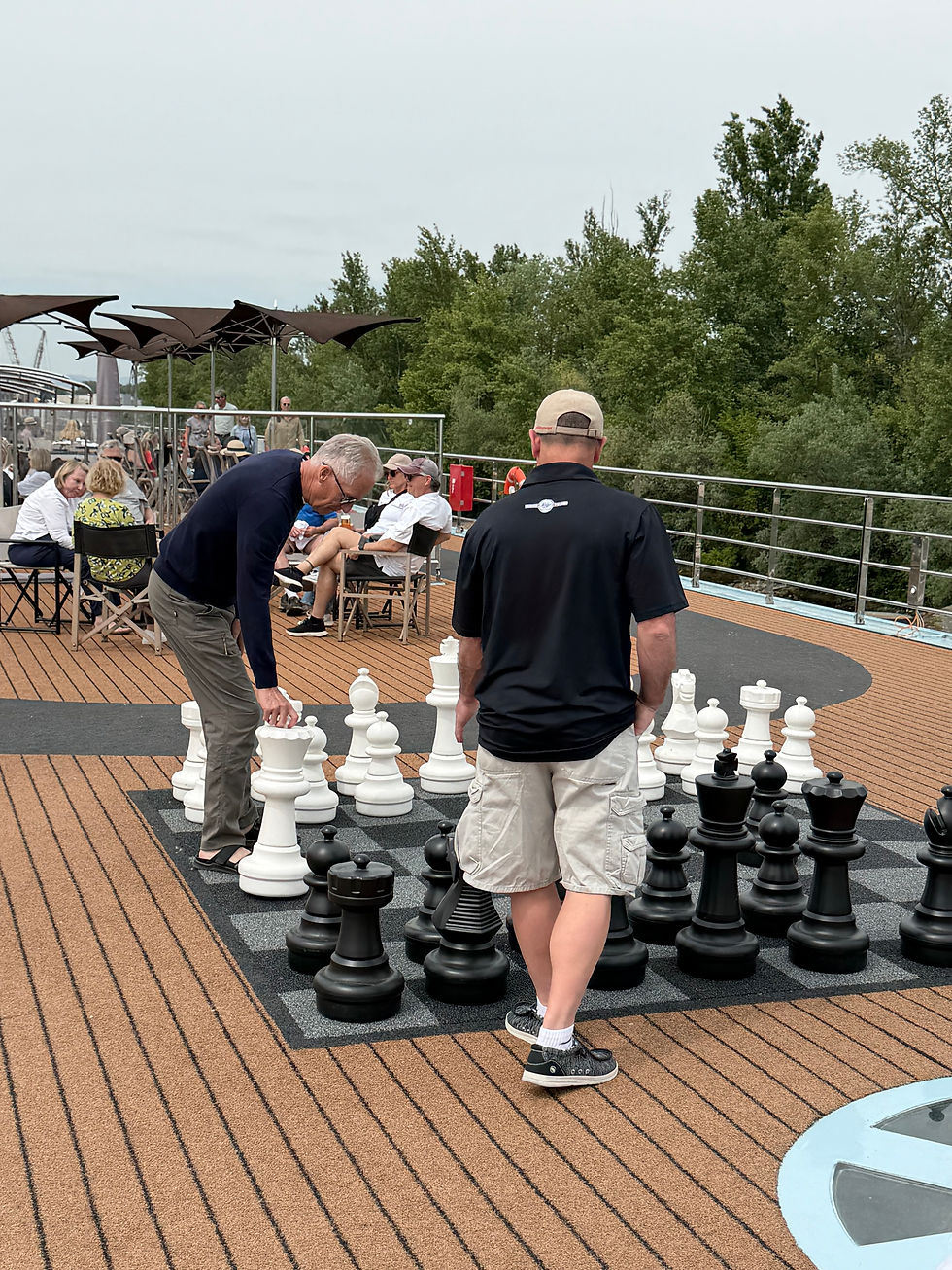
It was a quiet bus ride back to the ship, and we arrived at 1pm just as the on-deck BBQ was getting started. We got in line, filled our plates and joined our gang at their usual tables by the pool. There is a large chess set on the deck, and Jeff got up to start playing a match with Dan. Dan had never played chess (and I’d never seen JT play chess), but he started talking Dan through the process, then they just started playing a match. A few guys chipped in to help coach Dan. It kept them busy for a couple of hours!
Katarina came up to set up for a bands / 100’s class, and even though I’d been drinking wine for a few hours by then, I joined in. Jeff wrapped up his match and did the 100’s with me. We went through many locks this afternoon, with different configurations. One had a low clearance, and I saw for the first time how they lower the boat’s bridge before passing under. One lock had an overhang that was so low that Jeff could reach and touch it!
By then it was 4pm so we headed down to our cabin. I fell fast asleep for about an hour while Jeff showered. If he hadn’t wakened me up, I’d have slept all night! We went to cocktails, and then our group grabbed the two rooms in the main restaurant for our last night’s dinner. We sat with Mike and Kari, and Tim & Lisa. After dinner, I went back to our room to get the bottle of Port and we had no trouble finishing it with about 14 of us par-taking! We spent a little time in the lounge, then back to the room to pack and rest up for tomorrow’s long day of travel.
Wednesday April 29, 2026 - Travel Day
We disembarked in Basel, and had a guide that was pointing things out as we drove about 90 minutes to the airport in Zurich. The boat’s porters had taken our luggage off the ship and put it with the “pink tag” luggage. We steadfastly tracked our bags and watched them get loaded onto the bus. However, when all the bags were unloaded, we had a bag that DIDN’T belong to any of us. Not that it was my fault, but I felt so bad for someone who was without a bag and the poor tour guide that needed to track down the bag’s owner.
It was an easy flight from Zurich to Paris-CDG, where we had a three hour layover. We found solace in the Air France lounge for a bit, then walked around browsing shops and stretching our legs before the eight-hour flight to Detroit. That is always odd to gain those hours back. We left Paris at 4pm, and we landed in Detroit at 6pm! We had two hours to burn there, and sat in the Delta club and tried not to think about that it was past midnight in the time zone we’d become acclimated to!
We landed in Madison about 9pm CST and took an Uber home. Bone tired, but glad to have had a relatively easy day of travel.
Final thoughts:
Having just come off the WindStar cruise experience, it was a high bar for Ama to reach. I’d say they were great, but not fantastic. River cruising is so much more stable than ocean cruising - so none of that motion stuff. The walls of our room were so thin, it didn’t stop me from sleeping, but you could hear people walking in the halls and above us.
It was fun traveling with a group but also having flexibility to just be off on our own, or even to meet other interesting people that weren’t in our group.
I loved being back in Germany again. I’d like to do some cycling there - will have to add it to the list. I’d switched my Duolingo to German for about the last month and found it so much easier than Spanish. Can I speak it? No, but I understood more than I had previously!


Comments